First-Time Buyer Guide for San Francisco
Christopher Lee's definitive first-time buyer playbook for San Francisco — how to set a real budget, choose the right neighborhood, win in multiple offers, navigate TICs and condos, and avoid the mistakes that cost SF buyers six figures.
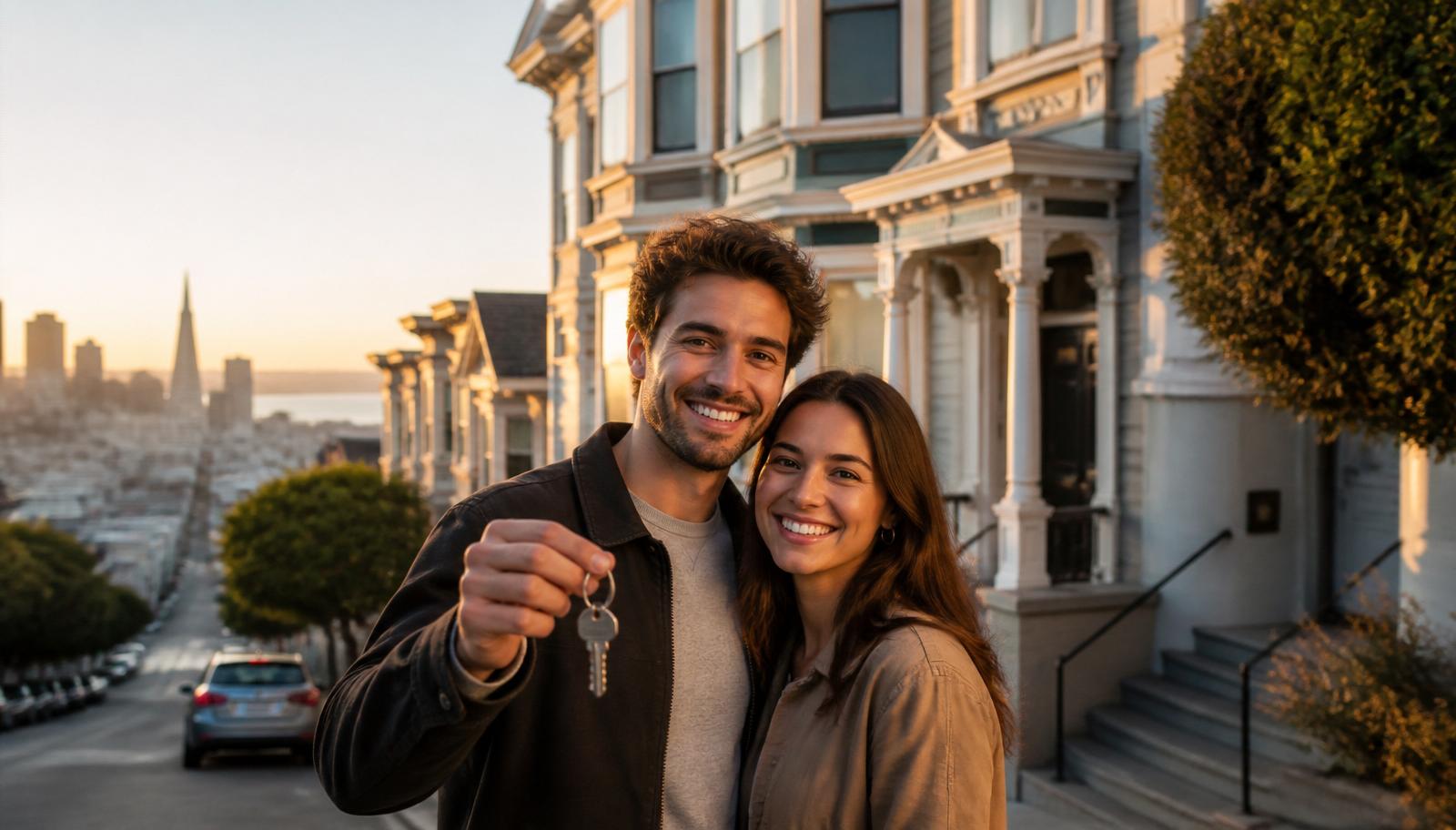
Photo: Clients of mine the morning they picked up keys to their first SF home — a remodeled Edwardian flat we bought $40,000 under list during a "competitive" weekend.
I'm Christopher Lee, a San Francisco Realtor and property manager (CA DRE #02120811). I've walked first-time buyers through every kind of SF deal — a starter condo in the Outer Sunset, a TIC in Pac Heights, a foggy Sunset bungalow, a six-bedroom estate in Forest Hill, and everything in between. This is the guide I wish every one of my clients had read before their first showing.
It's intentionally evergreen. Interest rates, inventory, and headlines shift every quarter — I cover that on the SF Real Estate Insights blog. What you'll read here are the mechanics, customs, and traps of buying in San Francisco that don't change, and the field-tested judgment calls that separate a great first purchase from an expensive mistake.
Want me to walk through your specific situation? Book a free 30-minute buyer consultation. No pressure, no pitch — just a frank read on what you can buy, where, and how to win it.
💡 Local Insight: San Francisco is roughly 47 square miles divided into ~40 distinct neighborhoods, three major fog patterns, two earthquake fault systems, and four common ownership structures. A "first-time buyer guide" that doesn't address all of those isn't a San Francisco guide — it's a national guide with a SF stock photo. This one is built for the city as it actually is.
Who this guide is for
- First-time buyers anywhere on the price spectrum, from a $700K condo in the Outer Sunset to a $3M single-family home on the west side.
- Bay Area renters who are tired of "paying someone else's mortgage" but feel locked out by SF prices.
- Tech employees with RSUs, ISOs, and double-trigger equity who need to coordinate vesting, AMT, and a down payment without triggering a tax disaster.
- Out-of-state and international buyers relocating into the city who have never seen a disclosure package, a TIC agreement, or a 3R report.
- Parents helping adult children with a down payment, co-signing, or buying as co-owners — common in SF and full of tax tripwires.
- Couples merging finances for the first time, where one partner has stronger credit, more cash, or different risk tolerance than the other.
If you fall into more than one bucket, that's the norm here — not the exception.
What most first-time buyers get wrong in San Francisco
After hundreds of SF transactions, the same handful of mistakes account for the bulk of regrets I see:
- Treating pre-approval as a target instead of a ceiling. Lenders approve at the top of the box. Your life is lived in the middle of it.
- Touring before reading disclosures. In SF, the disclosure package usually drops before offers are due. The buyers who win, read first.
- Confusing a condo with a TIC. They look identical at the open house. They are radically different to finance, resell, and refinance.
- Ignoring microclimate. I've had clients fall in love with a Cole Valley flat on a sunny Sunday and discover, two months in, that fog rolls in at 2 p.m. every summer afternoon.
- Skipping pre-inspections in a competitive offer. Then waiving contingencies blind. That's how five-figure surprises become six-figure regrets.
- Underestimating HOA reserves and special assessments on older Edwardian condo conversions — a $40K assessment for a new roof or facade can land in year two.
- Buying unpermitted square footage at full per-square-foot price, then discovering at resale that the appraiser refuses to count the in-law unit.
The rest of this guide is structured to make sure none of those happen to you.
⚠️ Common Mistake: Buyers who tour for six months without ever reading a full disclosure package show up to offer day under-informed and over-emotional. One mistake I regularly see is a buyer falling for a "remodeled" flat that turns out to have $80K of unpermitted work flagged in the 3R report — information that was sitting in the disclosure package the whole time.
The honest financial picture
San Francisco is one of the most expensive housing markets in the United States — but "expensive" hides enormous variation. I've closed a remodeled condo in the Excelsior for under $750K the same week I closed a single-family home in Noe Valley for $3.4M. Your number depends on three honest inputs.
1. Monthly carrying cost, not just price
Most buyers anchor on purchase price. Lenders anchor on debt-to-income. Neither is the right number. The right number is your total monthly housing cost — principal, interest, property tax, homeowner's insurance, HOA dues, and any Mello-Roos or special assessments — measured against your real life after retirement contributions, taxes, childcare, and savings goals.
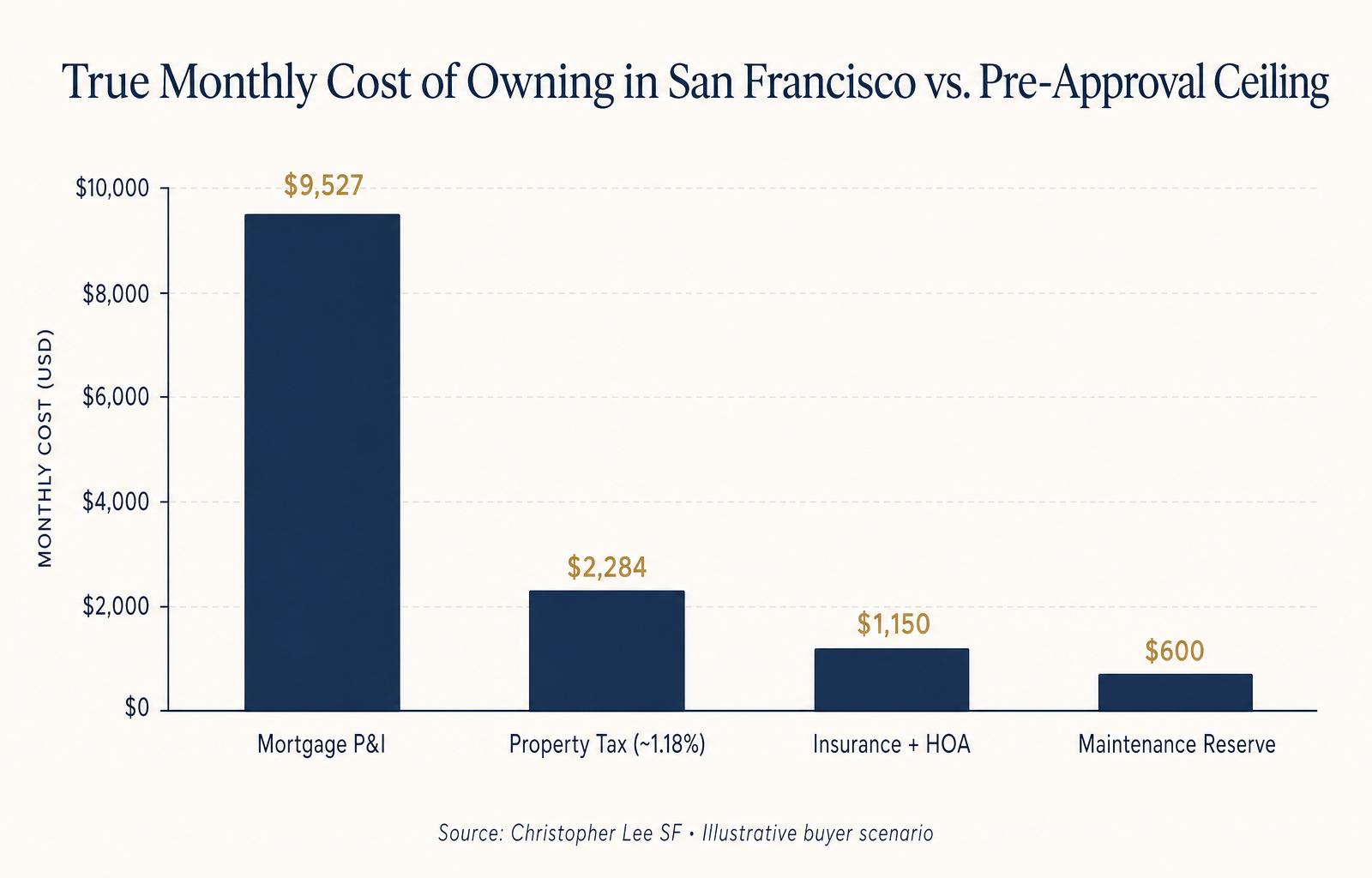
Illustrative breakdown for a $1.5M SF purchase with 20% down — the line items that pre-approval letters quietly leave out.
✅ Christopher's rule of thumb: If your true monthly housing cost exceeds 35% of your gross monthly income in San Francisco, you're house-rich and cash-poor. The buyers who stay under 30% sleep at night, refinance opportunistically, and almost never sell in a panic.
🧮 Run your real number first. The SF Buying Power Calculator converts a comfortable monthly payment into a real purchase price across down-payment and rate scenarios. It's the same tool I open on the first call with every new buyer client.
How the down payment changes everything
Here is the same $1.5M purchase across three common down-payment levels, using a representative 30-year fixed and SF property tax of ~1.18%:
| Scenario | Down payment | Loan amount | Monthly P&I (approx) | Property tax (monthly) | PMI | Approx. PITI |
|---|---|---|---|---|---|---|
| 5% down | $75,000 | $1,425,000 | $9,050 | $1,475 | ~$475 | ~$11,000 |
| 10% down | $150,000 | $1,350,000 | $8,575 | $1,475 | ~$340 | ~$10,390 |
| 20% down | $300,000 | $1,200,000 | $7,625 | $1,475 | $0 | ~$9,100 |
Illustrative only; your real number depends on rate, credit, and HOA. The point is the trade-off: lower down payment preserves cash and liquidity but costs more monthly and adds PMI; higher down payment lowers the monthly carry but ties up cash you might need for renovations or reserves.
2. Cash to close — what nobody tells you
The down payment is just the headline. In SF, plan for the full stack:
- Down payment — 3% on certain first-time programs up to 20%+ on jumbo. Most of my SF first-time buyers land at 10–20%.
- Closing costs — 1–2% of price for the buyer in SF (lender fees, title, escrow, recording, prepaid taxes and insurance).
- Reserves — most lenders want 2–12 months of housing payments in the bank after closing, especially on jumbo loans and condos.
- Move-in buffer — moving, immediate repairs, paint, blinds, and a "things break" fund. Budget at least $10–25K beyond closing.
- First property tax installment — SF property tax bills are paid in two installments. If you close near a due date, you may owe a prorated chunk almost immediately.
- Supplemental property tax bill — within 6–9 months of closing the Assessor will reassess your property at your purchase price and send a one-time supplemental bill for the difference. Many first-time buyers forget to set this aside and get a four- or five-figure surprise. See the SF Property Tax Lookup Guide for the full mechanics.
💰 Money-Saving Tip: Ask your lender for a line-item Loan Estimate from at least three lenders on the exact same loan amount, rate lock period, and close date. I've seen identical loans vary by $4,000–$8,000 in fees between lenders. That's a vacation, a kitchen appliance package, or six months of reserves.
Want someone to review your buyer net sheet line by line before you wire? Reach out and I'll do it at no cost, even if we haven't met yet.
3. Debt-to-income, credit, and the RSU question
Underwriters look at your total monthly debt payments divided by your gross monthly income. Two SF-specific notes:
- RSUs and bonuses can count as income if you have a documented two-year history and they're expected to continue. New hires often need creative structuring.
- Recently exercised ISOs and AMT can blow up your tax return and your DTI in the same year. Loop your CPA in before you exercise.
- Self-employment income in SF is often understated for tax purposes; underwriters use your tax returns, not your bank deposits. A bank-statement or asset-depletion jumbo may be the right product if your Schedule C looks lean.
- Parent-provided down payments must be documented as gifts with a signed gift letter — not a loan — and the funds usually need to be seasoned in your account for 60 days.
Pull your credit reports early, fix errors, and avoid opening new credit lines while you're shopping. Many of my clients are surprised when a single new credit card opened in escrow re-triggers a credit pull at the lender and delays funding by a week.
🚩 Red Flag: Do not pay off and close old credit accounts right before applying — closing accounts can drop your score by lowering your average age of credit and your utilization headroom. Pay them down, leave them open.
Loan options that actually matter in San Francisco
You don't need to be a mortgage expert. You do need to know which products are worth a real conversation with a lender.
| Loan type | Typical down payment | Best for SF buyers |
|---|---|---|
| Conventional conforming | 3–20% | Condos and outer-neighborhood homes under the conforming limit |
| Conventional high-balance | 5–20% | Most SF condos and many SFRs between the conforming and jumbo cap |
| Jumbo (full doc) | 10–20%+ | Pac Heights, Noe, Marina, Cole Valley, west side SFRs |
| Jumbo (asset-depletion / bank statement) | 20–30% | Self-employed, equity-rich, non-W-2 buyers |
| FHA | 3.5% | Lower down payments; condo building must be FHA-approved (rare in SF) |
| VA | 0% | Eligible service members and veterans |
| Doctor / professional | 5–10% | Physicians, dentists, attorneys with strong future income |
| Fractional / TIC loan | 10–25% | Required for tenancy-in-common purchases — only a handful of SF lenders |
My approach: I ask every first-time buyer to talk to at least three lenders — one big bank, one independent mortgage broker, and one credit union or portfolio lender. I have a short list of SF specialists I trust for jumbo and TIC loans, and I share them once we've had our first call.
Compare rate, points, lender credits, and total cash to close — not just the headline rate. A "lower" rate with two points of buy-down is often worse than a slightly higher rate with a lender credit.
Fixed vs. ARM in San Francisco
| Feature | 30-year fixed | 7/6 or 10/6 ARM |
|---|---|---|
| Rate behavior | Locked for full term | Locked for 7 or 10 years, then adjusts every 6 months |
| Typical SF use case | "Forever home" buyers, conservative cash-flow planning | Tech buyers with a 5–8 year horizon, large bonuses, or planned refinance |
| Risk | Higher starting rate | Payment can climb materially after fixed period |
| Refinance flexibility | Standard | Standard, but timing pressure if rates rise late in fixed term |
| Christopher's take | Default for most first-time buyers | Use it only if you've stress-tested the worst-case payment, in writing |
7- and 10-year ARMs can be powerful if you genuinely expect to sell, refinance, or pay off the loan inside the fixed period. They are dangerous if you plan to stay forever and rates move against you. I make every ARM client stress-test the worst-case adjusted payment, in writing, before they sign.
✅ Pro Tip: Ask any lender quoting you an ARM to print the fully-indexed worst-case payment under the contract caps. If they hesitate, find another lender. The good ones expect that question.
House, condo, TIC, or co-op? The SF ownership menu
This is the section out-of-state buyers underestimate the most. San Francisco has four common ownership structures, and they behave very differently.
| Structure | Typical SF discount vs. condo | Financing | Best for |
|---|---|---|---|
| Single-family home (SFR) | n/a (benchmark) | Standard conforming or jumbo | Long-term primary residence, families, appreciation |
| Condominium | n/a | Standard conforming or jumbo | First-time buyers wanting normal financing and resale |
| Tenancy-in-Common (TIC) | 20–30% less | Fractional loan, fewer lenders, higher rate | Long-horizon buyers comfortable with co-ownership |
| Condo-mapped TIC | 10–20% less | Fractional now, condo loan after conversion | Buyers willing to bet on a multi-year conversion process |
| Co-op | Varies | Specialized share loans | Rare in SF; usually historic buildings |
📍 Local Insight: A huge share of SF's "condo" inventory below $1M is actually TIC. At the open house they look identical — same Edwardian bay window, same hardwood, same staging package. The legal structure is buried in the disclosure package. One question I ask the listing agent before I even show a unit: "Is this a deeded condo, a fractional TIC, or a condo-mapped TIC?" The answer changes the financing, the resale ceiling, and the right offer price by six figures.
Condo vs. TIC vs. Single-Family — a buyer's-eye comparison
| Question | Single-family home | Condo | TIC |
|---|---|---|---|
| Do I own the dirt? | Yes | No (you own air space + a share of common areas) | No (you own a share of the building) |
| Who insures the structure? | You | The HOA master policy | The TIC group's master policy |
| Are there HOA dues? | Sometimes (rare) | Yes | Yes (often called "common expenses") |
| Can I refinance easily? | Yes | Yes | Only with a fractional lender |
| Resale pool | Largest | Large | Smallest (fewer eligible lenders) |
| Typical SF discount vs. SFR | 0% | ~25–40% less | ~40–55% less |
| Best for | Long-term primary, families | First-time buyers, condo lovers, lock-and-leave | Long-horizon buyers comfortable with co-ownership |
✅ Christopher's TIC rule: Only stretch into a TIC if you've (1) read the TIC agreement front-to-back with an attorney, (2) understand exactly how the fractional loan works, and (3) are genuinely comfortable being a long-term co-owner with the other unit owners. The discount is real. So is the resale ceiling.
A note on condo conversions and condo-mapped TICs
San Francisco's condo conversion lottery has been effectively closed for new entries for over a decade. "Condo-mapped TICs" are buildings that were converted before the freeze and behave like condos legally; "fractional TICs" are not converted and may never be. Never buy a fractional TIC assuming it will convert. Buy it because the unit, building, co-owners, and discount make sense as a TIC for the next 10+ years.
Earthquake retrofits, soft-story buildings, and other SF-specific structural issues
If you grew up east of the Rockies, the words "soft-story ordinance" mean nothing. In San Francisco, they can mean a $60K assessment in your first 18 months of ownership.
- Soft-story buildings — typically wood-framed multi-unit buildings with a ground-floor garage or commercial space. San Francisco's mandatory soft-story retrofit program requires bracing or steel-moment-frame work; ask whether the building you're buying is on the list, and whether the work is completed, permitted, or outstanding.
- Unreinforced masonry (URM) — much rarer in residential, but check.
- Foundations on older Victorians — many SF homes still sit on brick or rubble foundations that have never been bolted to the sill plate. A bolting and cripple-wall retrofit typically runs $10K–$30K and meaningfully reduces earthquake risk.
- Hillside homes — drainage, retaining walls, and slope stability deserve their own engineer.
🚩 Red Flag: A building advertised as "soft-story retrofitted" with no final permit attached. Ask for the permit number and verify on DBI before you remove your inspection contingency. I've seen "retrofitted" buildings that were halfway through the work and quietly abandoned.
Rent control, owner move-in, and tenant-occupied listings
San Francisco has one of the strongest tenant protection regimes in the country. For a first-time buyer this matters in three places:
- Buying a tenant-occupied unit. The lease conveys with the sale. You inherit the existing rent and the tenant. Owner move-in (OMI) evictions are legal under narrow circumstances but heavily regulated and very public — they are not a casual lever.
- Buying a multi-unit building. Rent-controlled units may have rents far below market. The "real" income of the building is the rent roll, not the pro-forma. Underwrite to current rent, not what you wish it were.
- Buying an Ellis-Acted building. Sellers sometimes Ellis-Act tenants out before listing. There are strict post-Ellis restrictions on re-renting and condo conversion. Have an attorney read the disclosures.
📍 Local Insight: I've also seen buyers lose homes because they assumed they could move into a tenant-occupied unit "in a few months." OMI in SF is not impossible, but it is slow, expensive, and emotionally taxing. If you need a vacant unit on day one, write your offer accordingly — or buy a different listing.
Choosing a San Francisco neighborhood
Neighborhood is the single biggest variable in your daily life: commute, fog line, parking, schools, weekend rhythm, and resale. SF microclimates are not a cliché — a 70°F afternoon in the Mission can be 55°F and windy in the Outer Richmond at the same hour.
Questions I ask every buyer:
- Where do you (and a future partner or kids) need to be most days?
- How do you feel about fog, hills, parking, and street noise — honestly?
- Are you optimizing for walkability, a yard, a garage, a view, or light?
- What does your ideal weekend look like — restaurants, parks, beach, gym?
- If you have or plan to have kids, what is your school plan (public lottery, private, parochial)?
Spend a weekend morning, a weekday evening, and at least one rainy afternoon in any neighborhood before you write an offer there. Then cross-reference with the San Francisco neighborhood guides — every guide includes my first-hand take, local favorites, and what buyers should know before they tour.
Microclimate cheat sheet
| Zone | Typical summer afternoon | What it means for buyers |
|---|---|---|
| Outer Sunset / Outer Richmond | 55–62°F, foggy, windy | Cooler, quieter, walkable to ocean — best value per square foot |
| Inner Sunset / Inner Richmond | 60–68°F, partial fog | Sweet spot for families wanting space without full fog |
| Cole Valley / Haight / NoPa | 65–72°F, mixed | Sunny mornings, fog usually rolls in late afternoon |
| Mission / Bernal Heights / Noe Valley | 70–80°F, sunny | The sun belt — premium pricing, premium light |
| Marina / Pac Heights / Russian Hill | 60–68°F, breezy | Bay-cooled, postcard views, top-of-market |
| Downtown / SoMa / Mission Bay | 60–70°F, windy corridors | Condo-heavy, lock-and-leave, commute-friendly |
✅ Pro Tip: Drive (or bike) your would-be commute at the actual time you'd be making it. A 4-mile trip from the Sunset to SoMa at 8:30 a.m. is a very different experience than the same trip at noon.
Need help narrowing your shortlist? I keep a running database of which SF neighborhoods consistently fit which buyer profiles. Tell me about your life and I'll send you the three or four I'd actually tour.
A quick decision tree
- If your top priority is sun and walkability → start in Noe Valley, Bernal Heights, the Mission, Cole Valley, NoPa.
- If your top priority is price per square foot → start in the Outer Sunset, Outer Richmond, Excelsior, Mission Terrace, Crocker-Amazon.
- If your top priority is views and prestige → start in Pacific Heights, Russian Hill, Telegraph Hill, Forest Hill, St. Francis Wood.
- If your top priority is commute to SoMa/FiDi and lock-and-leave → start in SoMa, Mission Bay, South Beach, Hayes Valley, Yerba Buena.
- If your top priority is family life with a yard → start in West Portal, Forest Hill, Miraloma Park, Glen Park, Sunset.
Building your team
A typical SF transaction involves more specialists than most first-time buyers expect:
- Buyer's agent — represents you, negotiates, coordinates inspections, reads disclosures, manages the timeline. Their fee is generally paid through the transaction; confirm the structure in writing.
- Lender or mortgage broker — issues pre-approval, locks the rate, funds the loan.
- Escrow / title officer — neutral third party who holds funds, clears title, and records the deed.
- Inspectors — general, pest (termite), sewer lateral, roof, chimney, foundation, and sometimes a structural engineer.
- Insurance agent — quotes homeowners and, if relevant, earthquake or flood policies.
- Real estate attorney — optional in California, but useful for TICs, trusts, probate sales, and unusual title situations.
- CPA / financial planner — essential if equity comp, self-employment, or a 1031 exchange is in play.
- Contractor or architect — even if you're buying "turnkey," a 30-minute walk-through with a contractor before you remove contingencies has saved my clients more money than almost any other line item.
When I represent a buyer, I bring a vetted bench in every one of these categories. You don't have to assemble the team from scratch.
How to read an SF disclosure package
In my experience helping buyers across San Francisco, the difference between winning a great deal and overpaying for a bad one usually lives inside a 300- to 500-page disclosure package. Most buyers skim it. The ones who read it carefully — or have a Realtor who does — win.
Here's the order I read them in, and what I'm hunting for in each section:
- Seller's disclosures (TDS, SPQ, SSD) — written by the seller. Look for everything they almost said. Vague answers are signals.
- Agent visual inspection (AVID) — the listing agent's walk-through. Sometimes catches what the seller "forgot."
- Natural Hazard Disclosure (NHD) — flood, fire, seismic, and special tax districts.
- 3R Report — SF's record of permitted and unpermitted work. Cross-reference every advertised "remodeled" feature.
- Preliminary title report — easements, CC&Rs, unpaid liens, encroachments. Mineral rights and shared driveways live here.
- Inspection reports — general, pest, roof, sewer lateral, sometimes foundation and chimney. The seller's inspector works for the seller; assume mild understatement.
- HOA package (condos and TICs) — bylaws, CC&Rs, financials, reserve study, minutes of the last 12 board meetings, current litigation. The reserve study and meeting minutes are where the real story lives.
- TIC agreement (TICs only) — financing structure, partition rights, buyout terms, group voting rules.
⚠️ Common Mistake: Many San Francisco disclosure packages exceed 300 pages. Buyers often focus on cosmetic items while overlooking reserve studies, sewer inspections, foundation reports, and permit history, which can have a much larger financial impact. A $15K kitchen fix is annoying. A $90K deferred-maintenance line in the reserve study is a different conversation.
Want a second set of eyes on a disclosure package before you write? Send it to me. I'll read it and call you back with the three things that actually matter. Reach out here.
The SF offer process, step by step
San Francisco moves fast and uses customs that surprise out-of-state buyers. Here's the rhythm of a typical financed deal:
- Get fully underwritten pre-approval. Stronger than a standard pre-qual letter; SF listing agents increasingly expect it.
- Tour and shortlist. Open houses are typically weekends; brokers' tours mid-week.
- Read the disclosure package early. Most SF listings publish a full disclosure package (inspections, reports, HOA docs, 3R report, NHD, preliminary title) before offers are due. Read every page, or have me read it with you.
- Pre-inspect if needed. In SF, waived contingencies are common in competitive deals, so smart buyers pay for inspections before writing the offer.
- Write a clean offer. Price, deposit, loan and appraisal contingencies (if any), inspection contingency (if any), close date, and seller-friendly terms like rent-backs.
- Submit by the offer deadline. Many listings have a set date; others review as received. I find out which one this is before we write.
- Negotiate or accept a counter. Best-and-final rounds are common with multiple offers.
- Open escrow and deposit earnest money — typically 3% of purchase price, wired to escrow within 1–3 business days.
- Complete remaining contingencies — appraisal, loan, HOA review, final inspection sign-off.
- Final walkthrough, sign loan docs, fund, record, get keys.
🚩 Never waive a contingency you don't understand. Waiving inspection, appraisal, or loan contingencies is common in competitive SF deals — but it shifts real financial risk to you. Before you sign, I'll show you, in dollars, exactly what each waiver means in a worst case.
To waive or not to waive — contingencies, side by side
| Contingency | What it protects | Cost of waiving (worst case) | When I tell clients it's reasonable to waive |
|---|---|---|---|
| Inspection | Right to renegotiate or walk after inspection findings | Surprise repairs paid 100% out of pocket | After thorough pre-inspections, on a building you understand |
| Appraisal | Right to renegotiate or walk if appraisal comes in low | You must cover the appraisal gap in cash | When you have liquid cash to bridge a likely gap and the comps are strong |
| Loan | Right to walk if your financing falls through | Loss of earnest money (typically 3% of price) | Only if you have fully underwritten approval and stable income |
| HOA review (condos) | Right to walk after reviewing HOA financials | Inheriting a building with weak reserves or active litigation | Almost never on first-time condo purchases |
How I help buyers win without overpaying
Multiple offers are not won by writing the highest number. They're won by writing the cleanest, most credible offer the seller has seen — and by knowing what that particular listing agent and seller actually care about.
What I do for every offer:
- Call the listing agent the day before offers are due to learn exactly what the seller wants — fast close, rent-back, certainty of funds, a specific contingency dropped.
- Pre-package inspections, proof of funds, and pre-approval into a single "offer file" the listing agent can hand to the seller without hunting.
- Stress-test the appraisal risk and tell you the real dollar gap if it comes in low.
- Write an offer that anticipates the counter — so we don't lose a deal in round two over something we could have addressed up front.
- Where appropriate, include a personal letter — handled carefully to stay inside fair-housing rules — that gives the seller a reason to pick you on a tie.
- Build a backup-offer strategy on the listings we love but lose, so we're in line if the first deal collapses.
This is the difference between buyers who win their second offer and buyers who write nine. I've seen buyers save tens of thousands by writing the second-highest number with the cleanest terms.
Before you write an offer:
- Have you read the full disclosure package?
- Have you done (or reviewed) a pre-inspection?
- Do you know the comps for the last 6 months on this block, not just this neighborhood?
- Do you know what the listing agent told me the seller actually wants?
- Have you stress-tested the worst-case payment if rates rise before you refinance?
If any answer is no, we have one more conversation before we submit.
Inspections that actually matter in SF
Every house in San Francisco is older than most of the country's housing stock. These are the inspections that matter most:
- General home inspection — baseline condition.
- Pest / termite ("Section 1" and "Section 2") — wood-destroying organisms and the conditions that lead to them. Almost mandatory on wood-framed Victorians and Edwardians.
- Sewer lateral — the pipe from the house to the city main. SF requires compliance on sale or major work; replacement runs $8K–$25K.
- Roof — especially on flat-roof buildings, which are everywhere in SF.
- Foundation / structural engineer — soft-story buildings, additions over garages, and homes on slopes deserve a closer look. SF has a soft-story retrofit ordinance that catches many older multi-units.
- Chimney — many SF chimneys are decorative now and need to be retrofitted or removed.
- Drainage and grading — water intrusion is the most common big-ticket surprise in SF, particularly on the west side.
- Electrical (knob-and-tube) — common in pre-1950s SF homes. Some insurers will not write a policy until it's replaced.
- Lead and asbestos screening — required disclosure on pre-1978 homes and a real cost factor on renovations.
Get written reports, not verbal summaries. If a seller pushes back on a pre-inspection, that's information.
💰 Money-Saving Tip: Bundle your inspectors. Many of the inspectors I work with offer a small discount if you book general + pest + sewer lateral on the same morning. Total cost typically runs $900–$1,500 for a condo and $1,500–$2,500 for a single-family home — cheap insurance compared to the cost of finding the wrong thing after closing.
Closing costs and the cash you actually need
Beyond the down payment, plan for roughly 1–2% of purchase price in buyer closing costs in San Francisco. The main line items:
- Escrow fee — split between buyer and seller per local custom.
- Title insurance — buyer typically pays the lender's policy; seller typically pays the owner's policy in SF.
- Lender fees — origination, underwriting, appraisal.
- Prepaid items — interest, property taxes, insurance reserves.
- Recording and transfer taxes — SF charges a city transfer tax on the seller; the buyer pays county recording fees.
- HOA transfer and document fees — for condos and TICs.
- Home warranty — optional but often included as a seller credit; useful in older SF homes.
Want a tighter estimate for your specific deal? Contact me and I'll run a buyer-side net sheet at no cost.
Buying vs. renting in San Francisco
| Factor | Buying | Renting |
|---|---|---|
| Time horizon to break even | Typically 5–7 years in SF | Any |
| Monthly cost certainty | High (fixed PITI for fixed-rate loans) | Low (rent increases capped by rent control only on covered units) |
| Wealth-building | Equity, appreciation, mortgage interest deduction | None on the property; cash freed up for other investments |
| Flexibility | Lower — transaction costs to exit | High — give 30-day notice |
| Tax treatment | Mortgage interest + property tax deductions (within SALT cap) | No deductions; renter's credit is small |
| Maintenance | Yours | Landlord's (and sometimes their problem becomes yours via repairs delayed) |
✅ Christopher's rule of thumb: If your honest time horizon in SF is under three years, rent. Between three and five years, run the math both ways with the SF Buying Power Calculator. Past five years, owning a comfortable payment almost always wins — and the city's long-term housing supply constraints work in owners' favor.
After You Close: Your First 90 Days as an SF Homeowner
The deal doesn't end at recording. What you do in the first three months protects your investment for the next decade. Here's the exact checklist I send every client the day their loan funds.
Week 1 — Lock down the basics
- ✅ Confirm property tax delivery address with the SF Assessor-Recorder so bills don't end up at the seller's old address.
- ✅ Document everything with dated photos at move-in — invaluable for insurance claims, future improvements, and eventual resale.
- ✅ Review your insurance policy line by line. SF earthquake coverage is optional, but pricing it is mandatory.
Month 1 — File the paperwork that saves you money
- 💰 Apply for the Homeowners' Exemption. Small but permanent reduction in assessed value for owner-occupants. Most buyers forget. See the SF Property Tax Lookup Guide.
- 📅 Set a calendar reminder for the supplemental property tax bill — it arrives 6–9 months after closing and surprises almost every first-time buyer.
- 🏦 Open a dedicated maintenance reserve account and fund it monthly. My baseline: 1% of property value per year for SFRs, less for condos with healthy HOA reserves.
Months 2–3 — Plan the long game
- 🔨 Plan permitted upgrades. Pull open and final permits via DBI before you start work. Unpermitted work haunts SF resales.
- 📜 Get your estate planning right. Title the property in a way that fits your long-term plan — sole, joint tenants, community property, or a revocable trust. Talk to an estate attorney.
- 🏘️ If you might rent it out one day, run a baseline number now with the SF Rent Estimator and read my landlord and property management guides.
Want this as a personal 90-day plan? I send every client a tailored post-closing roadmap with vendor recommendations, deadline reminders, and the contacts they'll actually need. Schedule a free consultation and I'll walk you through yours.
The most expensive mistakes I see SF first-time buyers make
- Falling in love with one listing and overbidding without local comps.
- Skipping the disclosure package because it's 400 pages.
- Underestimating HOA fees, special assessments, and reserve health on older condo buildings.
- Forgetting that TIC ≠ condo for financing and resale.
- Ignoring microclimate, commute, and noise during tours.
- Tapping retirement accounts in ways that trigger taxes and penalties.
- Buying at the top of pre-approval instead of the top of comfort.
- Waiving contingencies they don't understand because "everyone does."
- Assuming a tenant-occupied unit will be easy to deliver vacant.
- Treating the supplemental property tax bill as a surprise instead of a known line item.
Every one of these is preventable with one good conversation up front.
When buying might not be the right move
Buying is rarely a mistake over a 7–10 year horizon in San Francisco if the payment is comfortable. Renting often makes more sense when:
- You expect to leave SF within 2–3 years.
- Your job or relationship situation is in flux.
- You have not yet built a stable emergency fund.
- Your cash is better deployed in a business, equity comp strategy, or other investment.
A buyer's agent worth their fee will tell you when not to buy. I've told plenty of would-be clients to wait a year. Many of them came back, ready, and bought beautifully.
Where to go from here
You have three useful next steps, and they don't have to happen in this order:
- Run your numbers with the SF Buyer Buying Power Calculator and, if you may rent it out one day, the Rent Estimator.
- Pick your shortlist in the San Francisco neighborhood library and read the property mechanics in the SF Property Tax Lookup Guide.
- Book a free buyer consultation with me at /contact. Bring your questions, your spreadsheet, your dream listing — whatever you have. I'll give you a plan that fits your life, not someone else's template.
"Christopher made what felt impossible feel inevitable. He told us when to stretch and, more importantly, when to walk away. We're in our first home and we still trust every call he made." — recent first-time buyer client, Outer Sunset
This guide is general education, not legal, tax, or lending advice. Every transaction has its own facts; talk to qualified professionals before making decisions.
How to buy your first home in San Francisco — Christopher Lee's step-by-step playbook
- 1Set a comfortable monthly budget
Pick a total monthly housing cost (PITI plus HOA) that fits inside your real budget after taxes, retirement, and savings — not the maximum a lender will approve. Aim to stay under 35% of gross monthly income and ideally under 30%.
- 2Get fully underwritten pre-approval from 3 lenders
Talk to one big bank, one independent mortgage broker, and one credit union or portfolio lender. Compare rate, points, lender credits, and total cash to close. Fully underwritten approval beats a basic pre-qual in competitive SF offers.
- 3Build a real cash-to-close stack
Down payment plus 1 to 2% closing costs plus 2 to 12 months of reserves plus a 10 to 25K move-in buffer plus a supplemental property tax cushion. Have the funds seasoned and documented before you write.
- 4Choose your SF neighborhoods carefully
Visit on weekends, weekdays, and at least one rainy afternoon. Test the commute at real-life times. Use the SF neighborhood library and microclimate cheat sheet to narrow to three or four serious candidates.
- 5Decide on ownership structure
Single-family home, condo, TIC, or condo-mapped TIC — each has different financing, resale, and risk. Match the structure to your time horizon and tolerance for co-ownership.
- 6Read disclosure packages before you tour seriously
Inspections, 3R report, HOA financials, reserve study, TIC agreement, preliminary title. Read in the order that surfaces deal-breakers fastest — reserves, foundation, sewer, permit history.
- 7Pre-inspect before competitive offers
Bundle general, pest, and sewer lateral inspections on the same morning. Get written reports. Use the findings to either price the offer correctly or walk away early.
- 8Write a clean, credible offer
Price plus terms the seller actually wants — fast close, rent-back, certainty of funds, contingencies waived only where it's safe. Pre-package proof of funds, pre-approval, and inspections into one offer file.
- 9Open escrow and execute contingencies on schedule
Wire earnest money on time. Hit appraisal, loan, HOA, and final inspection deadlines. Communicate proactively with the listing agent — late or noisy buyers lose seller goodwill.
- 10Final walkthrough, sign, fund, record
Verify the home is in the condition agreed to. Sign loan docs at the title company. Funds wire, the deed records, and you get keys — usually within 24 to 72 hours of signing.
- 11Protect your investment in the first 90 days
File the Homeowners' Exemption, set up the maintenance reserve, plan permitted upgrades, calendar the supplemental tax bill, and price earthquake coverage even if you don't buy it.
Frequently asked questions
The questions San Francisco buyers, sellers, and landlords ask me most often on this topic. All answers are expanded by default — click any question to collapse it.
How much do I really need saved to buy a first home in San Francisco?+
Can I really buy a home in San Francisco with only 5% down?+
What credit score do I need to buy a home in San Francisco?+
Is it better to buy a condo, a single-family home, or a TIC in SF?+
What exactly is a TIC, and is buying one risky?+
Should I waive contingencies on my offer?+
Should I pick a 30-year fixed or an ARM in San Francisco?+
Do I really need pre-inspections before making an offer in San Francisco?+
How long does it take to close on a home in San Francisco?+
What are typical closing costs for a buyer in San Francisco?+
Can my parents help with the down payment?+
Can I use RSUs, stock, or crypto for my down payment?+
What is the supplemental property tax bill and how big will it be?+
What is a soft-story building and should I avoid one?+
Should I wait for prices or rates to drop before buying in SF?+
What neighborhoods are best for first-time buyers in San Francisco?+
Can I buy a home that is currently rented to a tenant?+
Why should I work with Christopher Lee as my SF buyer's agent?+
Related San Francisco guides
Keep going — these are the next reads I'd hand a buyer client after this one.
Look up any San Francisco property tax bill, parcel history, permit record, and assessed value the same way a working Realtor does — plus how supplemental bills, Prop 13, Prop 19, exemptions, and appeals actually affect what you pay.
The three ownership structures every San Francisco buyer evaluates — condominiums, tenancies-in-common, and single-family homes. Real cost differences, financing realities, and the trade-offs that actually matter.
Down payment is only one line. This guide walks through every dollar a San Francisco buyer needs at the closing table — lender fees, escrow, title, prorations, reserves, and the SF-specific items most first-time buyers miss.
What a real San Francisco pre-approval looks like — jumbo limits, asset documentation, RSU and bonus income, and how listing agents actually read your letter.
The complete, plain-English guide to San Francisco rent control: which buildings are covered, how much rent can legally go up, allowable passthroughs, owner move-in and Ellis Act rules, buyouts, and the mistakes that cost landlords and tenants the most money.
The pre-listing playbook San Francisco sellers actually need: which projects return more than they cost, what to skip, the realistic prep timeline, and how staging works in SF (where Victorians, Edwardians, and small-footprint condos each need different treatments).
How to evaluate, underwrite, finance, and operate San Francisco multi-family properties — written from over a decade of buy-side and listing experience. Covers cap rates, rent-controlled rent rolls, condo and TIC exits, soft-story risk, and the underwriting mistakes that quietly destroy returns.
How much home can you afford?
Run real numbers on jumbo loan limits, down payment, and monthly costs for a San Francisco purchase.